Enhancing reliability and explainability in industrial anomalous sound detection
Why physical AI needs to understand sound
Physical AI is becoming increasingly important as AI moves beyond digital data to sense, understand, and support decisions in the real world. In critical sectors like manufacturing, energy, and mobility, this technology is essential for keeping systems safe, reliable, and efficient.
Among the various ways AI "senses" its environment, sound is a particularly rich source of information—a direct window into a machine’s inner workings. Machines “speak” through sound, and subtle acoustic changes often reveal the earliest signs of wear, misalignment, or failure. This makes acoustic monitoring a natural approach for predictive maintenance.
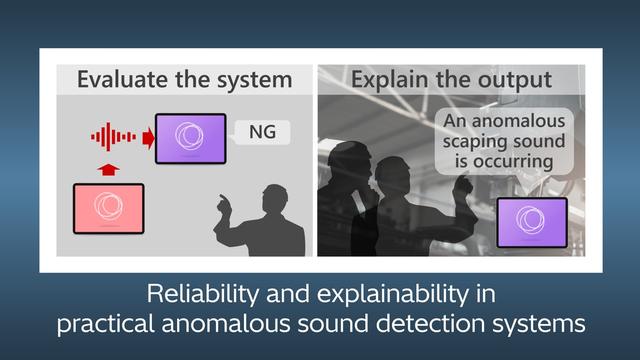
By continuously listening, we can detect unusual patterns and intervene before a breakdown occurs. However, building reliable and explainable anomalous sound detection systems remains a significant challenge. The fundamental hurdle is a lack of data: how can we design and assess models when real-world anomalous sounds are so rarely available? While methods exist to detect anomalies without relying on anomalous data, evaluating them remains difficult without real samples, making practical deployment challenging. In addition, even when an anomaly is detected, identifying the root cause of detected anomalies has traditionally depended on human expertise, because current systems cannot reliably explain why a sound is irregular. Therefore, conventional systems provide only limited benefits for improving the efficiency of subsequent repair and maintenance procedures.